

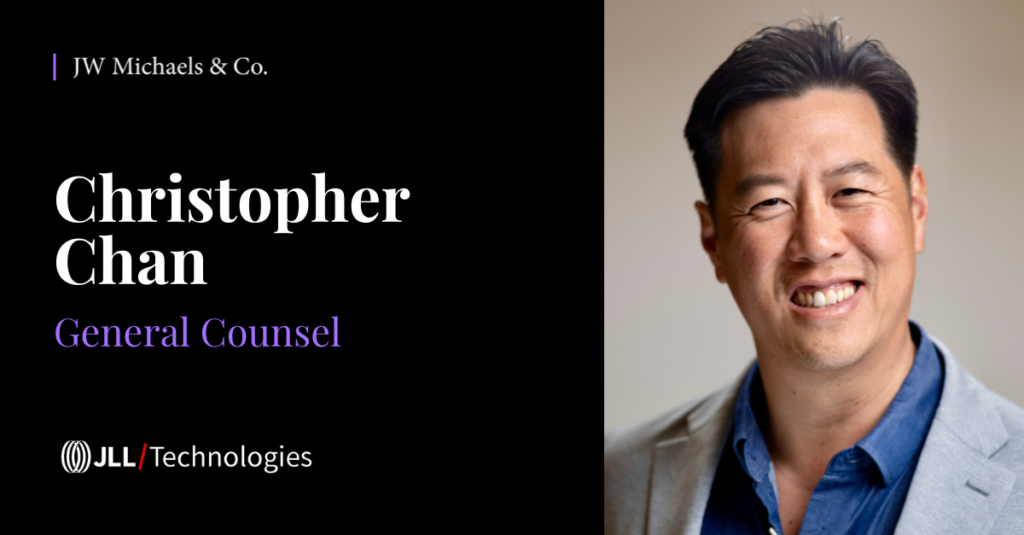
Christopher Y. Chan is General Counsel of JLL Technologies (JLLT), leading legal strategy for AI-driven solutions, data governance, venture capital, and intellectual property. He serves on both the JLLT Board and JLL's Legal Executive Committee.
Before moving to San Francisco, Chris was APAC General Counsel for JLL, leading over 70 lawyers across 15 countries from Singapore. He helped restructure a regionally driven business into a global business line and led the legal launch and adoption of JLL GPT, the company's proprietary large language model, across a workforce of more than 110,000 employees.
Prior to JLL, Chris was an Executive Vice President at Lazada (an Alibaba Group company) and RedMart, helping drive e-commerce growth across Southeast Asia. He also served as General Counsel and angel investor for a Silicon Valley startup through a successful exit. Earlier, he was a patent litigator at Finnegan, the first law clerk to the Honorable Raymond T. Chen at the Federal Circuit, and an international management consultant who set up outsourcing operations in India.
Chris has been recognized with NAPABA's Best Lawyers Under 40, the Association of Corporate Counsel's Top 10 30-Somethings, and Asia Legal Business's Southeast Asia In-house Lawyer of the Year, among other honors.
Outside of law, Chris is a licensed sailing captain, a rock climbing instructor, an Ironman finisher, and a craft beer judge.
Q: Tell us your path to your current role as General Counsel at JLL Technologies.
A: My path started somewhere unusual for a lawyer. Right after Duke, I moved to Pune, India to help open the first international office for a US management consulting firm, riding the globalization wave before I'd set foot in a law school classroom. Building something out of nothing in a market moving faster than the frameworks meant to govern it shaped how I think about legal work more than anything I learned afterward. From there I went to law school, practiced IP litigation at Finnegan, and clerked at the Federal Circuit during the explosion of patent litigation and so-called patent trolls, an early lesson in how fast the law gets forced to catch up to technology it didn't see coming. I then crossed back to Asia, building the legal, compliance, and government affairs function for a Series B e-commerce company through its acquisition by Alibaba, and later served as JLL's General Counsel for Asia Pacific, leading over 70 lawyers across 15 countries. I moved back to San Francisco to take on my current role as General Counsel of JLL Technologies, largely to be closer to where AI was being built.
Q: You've moved between startups, global multinationals, and different regions over the course of your career. What frameworks or decision points guided those transitions?
A: Less a framework, more a pattern I only recognized in hindsight: I kept moving toward places where the rules hadn't been written yet, rather than places with an established playbook. India in the early globalization years, Southeast Asian e-commerce before most legal departments had a category for it, and now AI governance, which barely existed three years ago. Each move meant trading seniority in an established system for being early somewhere that mattered more. The test I apply: does this role guarantee I'll keep growing, or does it just offer safety?
Q: How did your leadership style evolve as you moved from being a subject-matter expert in areas like privacy and data to owning the full General Counsel remit?
A: As a subject-matter expert, your value is depth. As General Counsel, it's synthesis. You're rarely the deepest expert on any single issue in front of you, litigation, M&A, employment, IP, but you become part of the connective tissue of the organization, one of the few people who has to see how all of it interacts with the business's actual priorities. The hardest shift was learning to trust my team more completely, and to spend my own energy on that connective work instead of trying to go deep everywhere myself.
Q: Having led large, geographically distributed legal teams, what have you learned about building trust and consistency across cultures and time zones?
A: Consistency doesn't mean uniformity. The instinct is to build one global playbook and roll it out everywhere, but local culture and business norms vary enough that pushing without understanding costs you credibility in a hurry. The best advice I ever got joining a new team: don't change anything too quickly. Meet people face to face, listen to how things work, then add your own gloss to it. I've watched new leaders bulldoze change from day one. It moves fast, but it burns the trust and local knowledge you need later.
Q: Many privacy and legal leaders struggle with being seen as either a blocker or a rubber stamp. What practical advice would you give for becoming a trusted business partner without compromising judgment or integrity?
A: Show up before you're asked. The blocker reputation comes from lawyers who only appear at the end, when the only tools left are yes or no. Get in the room early and you shape the thing itself instead of gating it at the finish line. The rubber-stamp reputation comes from the opposite failure, saying yes so reflexively your judgment stops meaning anything. The fix for both: build a fast, honest way to separate what's actually risky from what just looks unfamiliar, and explain your reasoning. People trust lawyers who show their work, even when the answer is no.
Q: As a General Counsel, how do you influence outcomes when you don't own the business decision but are ultimately accountable for the risk?
A: Through timing and framing, not authority I don't have. I try to get into a decision early enough that my input shapes the options on the table, not just react to one that's already made. And I frame risk in business terms. Nobody in an executive meeting is moved by "this creates litigation exposure." They're moved by what it means for a deal timeline or a client relationship. Translating legal risk into business consequence is most of the influence a GC has.
Q: How do strong relationships change your ability to deliver difficult advice, especially when business leaders are under pressure to move quickly?
A: Trust works like a bank account, you make deposits before you ever need to make a withdrawal. If the first time you've pushed back on someone is in the middle of their highest-pressure deal, they have no way of knowing whether you're being careful or just being difficult. If you've already built a track record of saying yes quickly when something's genuinely fine, your no carries real weight when it finally shows up.
Q: From your vantage point across AI, data, analytics, and technology, what risks do you think business leaders still underestimate?
A: Regional fragmentation, and how quickly the ground is shifting. Most executives treat AI risk as one global problem with one global answer. It isn't. The same use case can be fine in one region and a real liability in another, sometimes on the same day. Europe legislates ahead of the technology settling. The Gulf and Saudi Arabia are building frameworks from scratch. Parts of Asia wait to see how a technology is used before writing rules. And in China, the real question isn't which model to choose, but which models you're legally permitted to use at all. Layer on how much the industry conversation itself has whipsawed, from deploy AI everywhere, to conserve your tokens, to now weighing open weight models, and you get a sense of how little any single approach travels.
Q: How has the rise of enterprise AI changed expectations of the General Counsel compared to even a few years ago?
A: A few years ago, the GC's job with new technology was to manage a known risk: right contract terms, right compliance gaps, sign off before launch. With AI, the job has shifted to helping the board and the business understand a risk that's still outpacing anyone's ability to fully validate it. That's less about handing over an answer and more about showing how to decide well without the full picture. Law school doesn't prepare you for that posture. I think it's the single biggest shift in what leadership now expects from this seat.
Q: How do you balance privacy, data protection, and ethical considerations against other business risks and commercial imperatives?
A: I don't think of it as balancing separate categories, more a shared test applied to all of them: would I be comfortable defending this decision if it turned out to be wrong? That test doesn't care whether the risk is privacy, ethics, or straightforward commercial exposure, it forces the same rigor across all three. What changes case to case is how much scrutiny a decision needs before you can answer that question honestly, not the test itself.
Q: When risks are competing rather than clear-cut, what does good judgment look like from the GC seat?
A: Being explicit about the trade-off instead of pretending there isn't one. A GC who presents a clearly wrong path as obviously right isn't building trust, they're deferring a harder conversation. I'd rather lay out what we gain, what we're exposed to, and my honest read, and let the business leader make an informed call. Eliminating hard trade-offs was never the job. Making sure nobody's making one blind, that is.
Q: For lawyers aiming for the General Counsel role, how should they think differently than those pursuing a privacy SME or Chief Privacy Officer path?
A: A subject-matter path rewards going deeper than almost anyone else. A GC path rewards breadth, knowing enough across privacy, litigation, employment, and commercial law to sense when each one matters, and knowing the business well enough to sense which risks are worth slowing something down for. Learn how the company makes money, not just how the law applies to it. I'd add one thing that wasn't true a few years ago: technical fluency is becoming a must-have too. Every company is being restructured by AI. Better to show up with an informed opinion than have the decision made without you in the room.
Q: You've built a significant portion of your career overseas. How do lawyers practically position themselves to move geographies, particularly from the U.S. to international roles?
A: Go toward the regions where the legal function is still being built, not the ones where the org chart is already full. For me that was India, then Southeast Asian e-commerce, markets that needed someone willing to build a legal function from nothing rather than slot into an existing one. That's usually an easier door than trying to land a fully-formed international GC role from outside. It also teaches you things, building from scratch, operating without a playbook, that are hard to learn any other way.
Q: What surprised you most when you first stepped into a full General Counsel role compared to operating as a privacy or data leader?
A: How much of the job is translation, not legal analysis. As a subject-matter leader, my audience already spoke some version of my language. As GC, my audience is the board or a business leader who doesn't think in legal terms and won't act on advice they can't translate into their own priorities. I underestimated how much of the job is making complex risk legible to people focused, quite reasonably, on something else entirely.
Q: Looking back, which relationships proved most critical to your effectiveness as a GC, and why?
A: The people who had no reason to make me look good and told me the truth anyway. Every GC has plenty of people telling them what they want to hear. Feedback is a gift, but only if someone's willing to give it to you honestly. The relationships that made me better were the ones that flagged a hole in a plan before it became a public problem. Those take longer to build than a merely cordial one, but they're the ones that protect you.
Q: What are you working on that you're excited about?
A: Building AI governance that genuinely works across our full global footprint, rather than a framework built for one region and stretched to fit the rest afterward. It's some of the most unresolved work I've done in my career, which is part of why it's energizing rather than exhausting.
Q: What are you working on that worries you?
A: The gap between how fast client and regulatory expectations around AI transparency are moving, and how far the underlying tools are from supporting that level of transparency. Clients increasingly want a level of disclosure most models weren't built to produce yet. That gap is going to cause real friction before the industry catches up to it. I suspect most of us are further behind on solving it than we'd like to admit, including companies who think they've already got it handled.
Q: Any other closing thoughts you'd like to share?
A: The instinct I'd want any lawyer to carry into this moment isn't a rulebook, it's a habit: before you act, ask whether you'd still be comfortable defending the decision if it turned out you were wrong. With AI, most tools, regulations, and framework in this interview will be outdated in a few years. That question won't be.
Sooji Seo serves as 3M's Senior Vice President and General Counsel, Information & Dig...
Read More
As part of our Captains of Industry Interview series, Lawrence Brown, Sr. VP Legal, Houst...
Read More
Introduction & Background Q: You’ve had an extraordinary career spanning the privat...
Read More